
Frankenstein Mouse Experiments
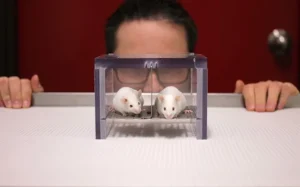
What is it like to be a mouse? It’s impossible to know, but if you’re a mouse which has had human cells implanted into its brain, one can say with a high degree of certainty that it’s not much fun.
According to a recent report by the BBC, twenty-two intrepid researchers at Stanford University in America have created a ‘part-human part-mouse brain developed in science breakthrough.’ More specifically, ‘Neuroscientists in the US have successfully adapted mice to have functioning human cells inside their own brains.’ Wow.
We are further informed: ‘The researchers hope [sic] that potential [sic] treatments for psychiatric and neurodevelopmental diseases that only occur in humans could now be tested on laboratory rodents…The animals were genetically engineered – and surgically altered – so that some of their brain tissue is human.’ (My emphasis.)
Not to worry. ‘The scientists said their work was carried out with independent ethical scrutiny.’ So that’s all right then.
Lead researcher Professor Sergiu Pașca explained in a press conference, ‘Psychiatry has one of the lowest success rates for clinical trials.’ The reason for this, the good profession explained, is that drugs that seem to be working well in [so-called] animal models, fail dramatically in humans. Oh dear.
In spite of this damning admission, ‘The Stanford researchers said that, for some complex conditions, including epilepsy, autism, and cerebral palsy, this research has the potential [sic] to be transformative.’ And the reason for such optimism, we are told, is because ‘We have a new model that allows us to capture aspects of human brain function in a way that has not been possible before.’
And how did they do that? The actual paper, published in the journal Nature, is highly technical but you don’t need to be an expert in this field to see two glaringly obvious commonsense objections to this kind of work.
First, these experiments were extremely cruel. The poor mice, apart from being kept in laboratory cages totally unlike their natural environment, were genetically engineered so that the cortex (grey matter) of their brains was missing. Then, they were injected with human skin cells which organised themselves to function as quasi-mouse brains. But, to test whether the mice behaved like mice which had not been experimented upon, they were tortured with electric shocks, had their skin and footpads prodded by filaments with increasing force, were made to stand on hot plates, and were subjected to oxygen deprivation (hypoxia). No, I mustn’t exaggerate. We are reassuringly told that the shocks were mild, the temperature of the hot plates was only 55°C, and the oxygen deprivation was induced gradually. Finally, under anaesthesia these animals had the tops of their skulls removed so the brains could be studied directly, soon after which they were killed.
Second, it’s a huge assumption that what may or may not happen in these hapless animals has any relevance for human development or understanding of so-called neurodevelopmental disorders in humans. Part of the reason for this is that what are called psychiatric and neurodevelopmental disorders have no objective biological basis.
I’m not the only one to have doubts about the ethics and usefulness of such experiments. Dr Sarah Chan, a reader in bioethics at the University of Edinburgh who was not involved in this research, told BBC News: ‘There was no indication that what’s being created here are mice that can think like humans, or a human brain in a mouse body.’ She added, ‘How can we know what it’s like to be one of these mice? And how do we take account of that in the ways that we treat laboratory animals?’
The conclusion of the paper was: ‘We envision [sic] that xenocortication will be useful for obtaining circuit- and behaviour-level readouts using human neurons to study neurodevelopment, model disease, and develop therapeutics.’
What this means is that by implanting human cells into mice brains, the experimenters hope this will be useful for studying human neurodevelopment, disease, and treatments.
They can go on envisioning till the cows come home, but what is the scientific basis for believing that these ghoulish experiments will advance our knowledge of and treatment for human ailments? There is none.
Text © Gabriel Symonds